
Visibility as a Financial Instrument
You cannot manage what you cannot see, and in the era of high-density edge compute, ‘invisible’ energy waste is a direct drain on valuation. The first step in turning energy into a strategic advantage is achieving real-time visibility and control.
By integrating connected platforms like Tower IoT from AN10 Inc, operators gain granular data on energy consumption and site conditions across the entire network. This isn't just a technical dashboard; it is a financial instrument that allows for:
Precision OPEX Management: Identifying ‘power-hungry’ legacy equipment for decommissioning based on real-time efficiency metrics.
Predictive Maintenance: Using IoT data to prevent costly site failures before they happen, significantly improving network resilience.
Active Operations: Dynamically adjusting individual site parameters in real-time to achieve important efficiency gains.
Dynamic Load Balancing: Shifting AI-compute tasks between sites based on which location has the cheapest or "greenest" power available at that exact moment.
Hybrid Power: The Bridge to AI Revenue
We have already discussed the ‘Grid Lock’ - the 4-to-8-year lead time for utility upgrades. Strategically, Hybrid Power Systems are the only way to bypass this bottleneck and capture early-mover advantages in the AI market.
A sophisticated hybrid system - combining solar, advanced battery storage (BESS), and smart-grid interaction - serves three critical financial functions:
Peak Shaving: AI processing creates massive, unpredictable ‘spikes’ in power demand. Hybrid systems use batteries to ‘shave’ these peaks, reducing the urgency for massive (and expensive) grid-feed upgrades.
Revenue Acceleration: Hybrid systems allow an operator to deploy AI-ready edge compute today, rather than waiting years for a grid provider. This grants a 1 to 2-year lead in capturing high-margin B2B contracts for low-latency services.
Diesel Displacement: Moving away from diesel dependency directly lowers one of the most volatile OPEX lines while simultaneously satisfying sustainability mandates.
Whilst the benefits of such hybrid power systems are clear, they do of course need space at sites and if this is governed by TowerCo contracts this could trigger a competitive ‘gold rush’ between operators for such space.
The AI-Optimisation Loop
There is a poetic irony in the new infrastructure: we must leverage AI-driven optimisation to manage the very power that sustains the AI network.
While AI in telecoms is often discussed as a tool for radio optimisation, its greatest financial impact may be in energy orchestration. Advanced algorithms can deliver double-digit cost savings by dynamically adjusting power intake, storage, and consumption across thousands of sites simultaneously. This creates a ‘virtuous cycle’ where the network becomes more efficient the more it is used, driving down the cost per bit - the ultimate metric for future competitive advantage.
Building the Competence Moat
There is currently a significant competence gap in the industry. Most traditional organisations lack the internal expertise to design, specify, and deploy high efficiency hybrid power systems.
For senior management, the strategic move is not necessarily to build this expertise from scratch, but to partner for competence. By engaging with a specialist partner ecosystem that understands both the hardware of power systems and the software of AI-based management, operators can move with the speed of a software company rather than the inertia of a utility.
Conclusion: The New Value Metric
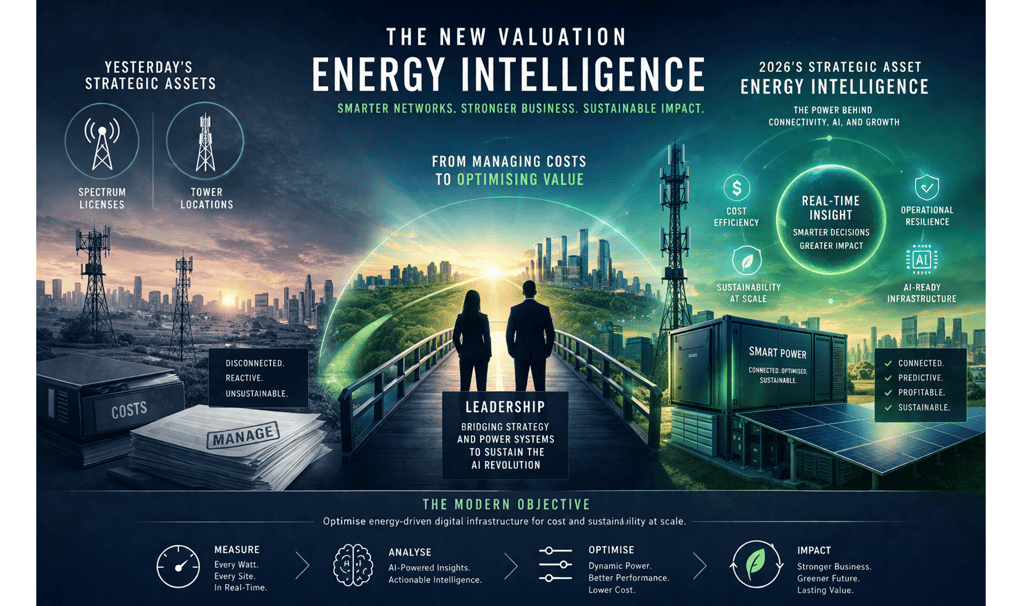
The transition from telecoms network management to include AI and energy strategy is the core of the business model. Infrastructure that is “AI-ready” and features resilient, modular, and sustainable energy systems will inherently carry a higher valuation and lower long-term risk profile.
The question is no longer, "How do we power our network?" but "How do we turn every watt into a strategic advantage?".
In the final article of this series, "The New Valuation," we will look at how the shift to energy-efficient infrastructure is fundamentally changing how VCs and Private Equity firms value telecommunications assets.
#Telecoms #AIStrategy #EnergyEfficiency #Sustainability #IoT #HybridPower #CFOAdvisory