The New Valuation Metric
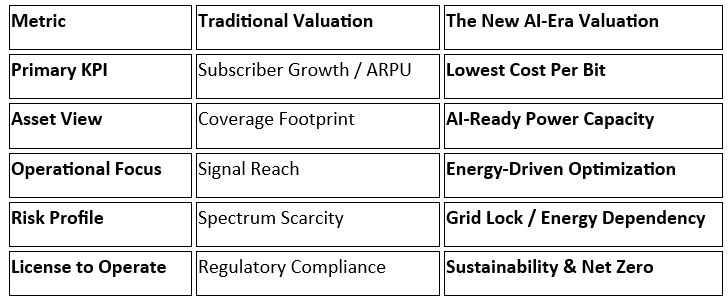
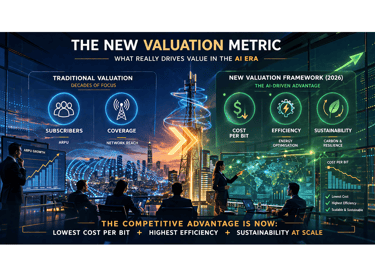
For decades, the valuation of telecommunications companies was governed by two simple pillars: Subscribers and Coverage. In boardrooms, growth was measured by ARPU (Average Revenue Per User), market share of subscribers and the physical reach of the network. But as we move into the AI era, these metrics are losing their predictive power. For VCs, Private Equity firms, and the leadership of publicly listed operators, a new valuation framework is emerging. As of 2026, the future competitive advantage is no longer defined by who has the fastest network, but by who can deliver the lowest cost per bit with the highest efficiency and sustainability.
Greg Coombs
2 min read

The Shift: From Growth to Energy-Adjusted Value
Historically, infrastructure was seen as a static asset. In the AI era, it is a dynamic energy consumer. This shift is fundamentally changing how investors value telecommunications assets:
The Efficiency Premium: Investors are increasingly looking at Energy Intensity (the energy required to move one gigabyte of data). Operators who utilise AI-driven optimisation and power design expertise to drive down this metric will be rewarded with higher valuation multiples.
The ‘Stranded Asset’ Risk: Infrastructure that is not "AI-ready" - meaning it lacks the modular power systems or grid capacity to support edge compute where it is needed - is now viewed as a long-term liability.
Sustainability as a License to Operate: Net Zero commitments are no longer just ESG footnotes; they are becoming part of the regulatory license to operate. Companies with lower carbon footprints are securing a lower cost of capital.
Reporting to the Board: The Strategic Narrative
For senior leadership, the ability to report a robust energy-driven infrastructure strategy to the Board is critical for raising share valuations and preparing for IPOs. The Board isn't just interested in the cost of energy; they are interested in the resilience and readiness of the asset.
A modern reporting framework for the Board should focus on:
Grid Capacity Security: Progress on upgrading site power feeds to avoid the multi-year ‘Grid Lock’ and securing upgrade advantages over competitors.
Edge AI Readiness: The percentage of the site portfolio capable of hosting high-density compute facilities and their coverage proximity in being able to efficiently support the most likely to be adopted low-latency services.
Autonomous Energy Systems: The integration of hybrid power and IoT platforms (like Tower IoT) to reduce diesel dependency and improve real-time operational control for optimum efficiency.
Aligning Leadership Incentives
This is not just a corporate strategy; it is a personal one for leadership teams. Executives often have significant wealth tied to the company through share options or direct investment. By shifting the company's focus toward energy-driven digital infrastructure, they are directly insulating their own portfolios against the ‘perfect storm’ of rising OPEX and infrastructure obsolescence.
Investing in power-efficient infrastructure today creates a ‘valuation moat’. It ensures that when the "AI Revolution" fully takes hold, the company is not just a utility provider, but the primary landlord of the AI-compute economy.
Summary: The Evolution of Value Metrics
Conclusion: A Call to Action for the C-Suite
The shift from telecoms network management to include AI infrastructure and energy strategy is the core of the business model. For energy strategy, the modern operator must answer: "How do we turn every watt into a strategic advantage?"
Those who lead this change will oversee the most efficient, resilient, and valuable networks in history. Those who fail to act will find themselves with the fastest signals in the world - and no sustainable way to keep the lights on.
Final Thoughts on this Series
This five-part series has outlined a roadmap from existential threat to competitive dominance. By moving from ‘managing’ to ‘optimising’, and by bridging the ‘competence gap’ with a partner ecosystem, operators and TowerCos can transform energy from a burden into their greatest strategic asset.
Which of these strategic pivots - Grid Security, Hybrid Power, or Valuations - is the most pressing priority for your Board this year?
#Telecoms #AIStrategy #Valuation #DigitalInfrastructure #Sustainability #TowerCo #CFOAdvisory
Part 5 of a 5-part series