The Carbon Dividend
How Telecom Leaders are Turning Decarbonisation into a Competitive Moat
2/24/20262 min read


The global telecommunications landscape is undergoing a fundamental shift toward a mandatory decarbonisation model. For years, Mobile Network Operators (MNOs) and Tower Companies (TowerCos) have viewed environmental regulations primarily as a cost centre. Sustainability initiatives often stall against the friction of high upfront CAPEX and the rigid demand for three-year payback periods.
However, a new paradigm is emerging. By integrating carbon credit mechanisms, forward-thinking executives are transforming environmental liabilities into strategic assets. For a market-leading operator, a robust carbon reduction program offers far more than simple compliance; it serves as a strategic engine for value creation.
Bridging the "Green Premium" Gap
The "green premium"—the additional cost of choosing a clean technology over one that emits greenhouse gases—has long been the primary obstacle to large-scale sustainability investment. Leveraging carbon credits allows organisations to bridge this gap, using market-based instruments to offset operational costs while aligning with international regulatory frameworks.
High-quality carbon credits currently command prices between $50 and $200 per ton of CO2. By monetising emissions reductions, operators generate a new revenue stream that effectively subsidises the transition to renewable energy.
Operational Excellence and Network Resilience
The benefits of this transition extend deep into the core of network operations:
Reduced OPEX: Upgrading to high-efficiency power systems and AI-driven cooling solutions directly lowers utility expenditures through a systematic decrease in kilowatt-hour consumption.
Enhanced Reliability: Modernised, energy-efficient infrastructure correlates with greater network uptime.
Revenue Protection: Increased reliability leads to improved stability and significantly lower customer churn—a critical advantage in the highly competitive MNO space.
The Financial Engineering of Carbon
Beyond internal efficiencies, this strategy unlocks unique fiscal benefits. High-quality carbon reduction projects signal a lower risk profile to the global financial market, granting priority access to "green" finance and low-cost funding from major institutions like the World Bank.
Every metric ton of CO2 reduced, removed, or avoided generates one carbon credit. These credits provide the flexibility to either offset unavoidable emissions or be sold on the Voluntary Carbon Market (VCM) for direct profit.
A Proven ROI Model
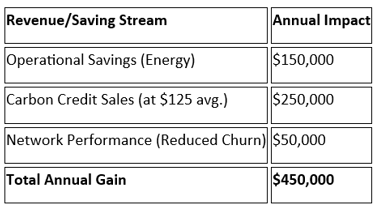
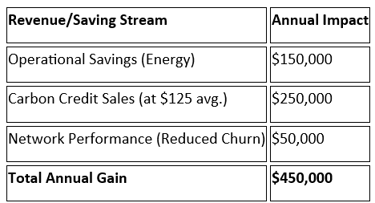
To illustrate the impact, consider a mid-sized data centre facility upgrading its cooling and power distribution at a CAPEX of $1,000,000. With an initial baseline of 10,000 tons of CO2 and a 20% efficiency gain, the facility reduces emissions by 2,000 tons annually.
Under this model, the payback period is just 2.2 years. Without carbon credit monetisation, that same project would take five years to pay back—a duration that typically leads to internal rejection.
Conclusion: From Compliance Taker to Market Maker
The choice for telecom executives is clear: lead the transition or be forced to follow it. Early adopters who establish high-integrity carbon standards secure a "seat at the table" with government bodies, helping to set the strategy for future regulatory governance. While competitors struggle to adapt to future "Cap-and-Trade" mandates, leaders will already have an established portfolio of credits to navigate lowering emission caps.
Are you ready to turn your emissions into profit and fuel your future with carbon-free solutions? Contact us today for an initial discussion on how we can help you baseline your operations and develop a customised carbon monetisation roadmap.