
Steel and Grass vs. Power and Pixels
The decades-long 'steel and grass' business model of TowerCo's is changing
Greg Coombs
3 min read
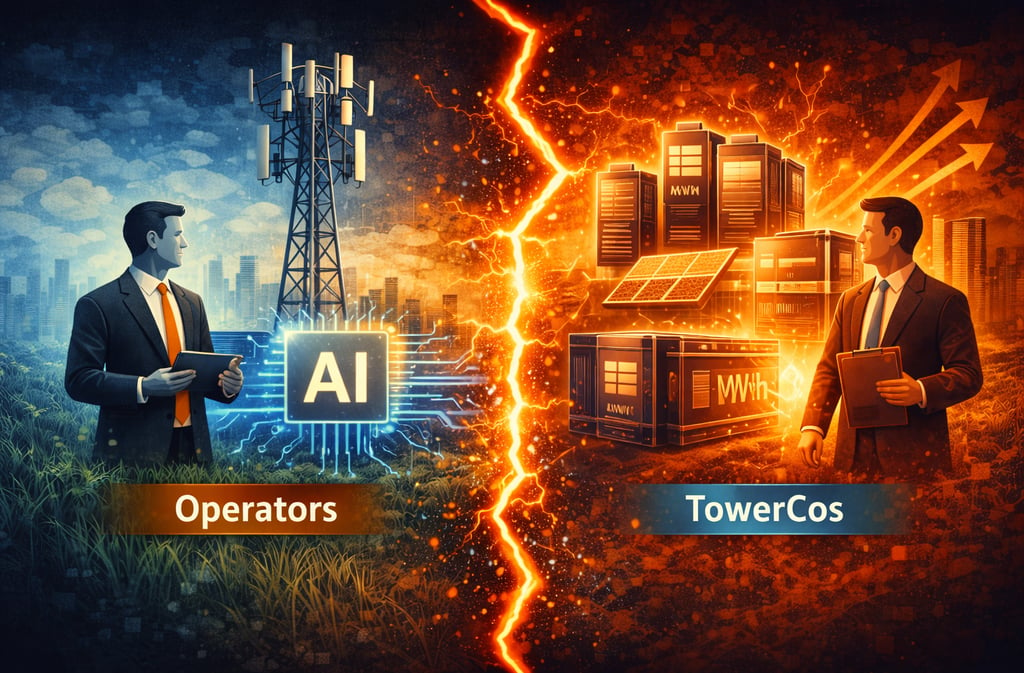
Over the last decade and more, the relationship between mobile operators and TowerCos has been defined by a relatively simple "Steel and Grass" model. Operators offloaded their passive infrastructure to lighten their balance sheets, and TowerCos focused on maximising tenancy ratios and minimising maintenance costs. It was a deal that suited both parties in a coverage-centric world.
However, the AI revolution is about to potentially put this relationship on a collision course. As operators look to deploy high-density edge compute, the ‘passive’ site must suddenly become very ‘active’. This shift creates a fundamental dilemma: Can TowerCos be convinced to make the necessary investments in power systems to support the dramatic expansion in site load that accompanies AI facilities?
The Collision: The Incentive Gap
The primary threat is a misalignment of incentives. Traditionally, TowerCos are incentivised to keep CAPEX low. Upgrading a site to handle the 2x or 4x power increase required for AI-ready edge compute is an expensive undertaking. Incentives are strained even more when realising that planning, local government permissions, and any necessary civil Works may need to be done years in advance of the increase in site load.
If the TowerCo views itself merely as a landlord of physical space, and the Operator views energy as an unavoidable expense, the result is a stalemate. The Operator cannot deploy the low-latency services they need to compete, and the TowerCo risks holding a portfolio of ‘stranded assets’ - sites that are geographically functional for operator coverage but technologically obsolete because they lack the ‘juice’ to power the AI era.
The Opportunity: Energy-as-a-Service (EaaS)
The alternative to collision is a radical evolution of the business model. There is a massive opportunity to turn energy from a cost centre into a strategic asset and a source of new revenue.
Forward-thinking TowerCos are transitioning into Energy-as-a-Service (EaaS) providers. By investing in sophisticated hybrid power systems - integrating solar, battery storage, and smart-grid interaction - TowerCos can offer more than just a mast; they can offer guaranteed, high-density, green power.
For the Operator, this means:
Faster Time-to-Market: Avoiding the ‘Grid Lock’ by using the TowerCo's pre-installed hybrid power buffers and partnering with them to develop grid-feed upgrades.
OPEX Stability: More predictable energy costs through a managed service model.
Sustainability Gains: Directly meeting Net Zero mandates through the TowerCo’s green infrastructure.
The Competence Gap
This transition is hampered by a significant competence gap. Most traditional TowerCo and Operator organisations do not currently possess the internal expertise to design, specify, and deploy the sophisticated power systems required for this new era. Expertise in hybrid hardware, vendor selection for advanced energy systems, and remote AI-based management is often missing from traditional structures.
To bridge this, leaders must look toward a partner ecosystem. Integrating platforms like Tower IoT allows both parties to gain real-time, granular visibility into energy consumption and site conditions, creating a connected energy ecosystem rather than isolated, unmanaged sites. The partnership is strengthened by the platform allowing operators to smooth peaks in AI processor load across RAN network sites whilst simultaneously smoothing the peaks in power requirement that such loads generate.
The CFO’s Nuclear Option: The Strategic Buy-Back
For Operator CFOs, this presents a difficult strategic choice. If a TowerCo partner is unwilling or unable to modernise the power facilities at critical sites, the Operator faces a competitive existential threat.
This brings a ‘nuclear option’ to the table: The Strategic Buy-Back. While the industry has spent years divesting towers, the mission-critical nature of AI-power might force some operators to re-acquire key ‘Tier 1’ sites to ensure they have total control over the energy infrastructure. It is a capital-intensive move that reverses a decade of financial strategy, but in the battle for AI supremacy, control over the power feed and site facilities may be more valuable than a lean balance sheet. In the case of multi-tenant sites, a buy-back could provide a strategic advantage to one operator at the expense of others by blocking competitor AI deployment plans.
The Path Forward
The shift from management of a telecoms network to energy strategy for a hybrid network of telecoms and AI infrastructure is not a technical footnote; it is the core of the business model. Senior management must act now to:
Re-negotiate MSA terms: Move toward "Energy-as-a-Service" agreements that incentivise TowerCo investment and close cooperation over network development plans.
Build or Partner for Competence: Recognise the lack of internal power design expertise and engage with specialist partners.
Evaluate Portfolio Control: Identify sites where power upgrades are non-negotiable and be prepared to take direct control if partners lag or it makes sense for competition strategy.
The question is no longer, "How do we share a mast?" but "How do we co-invest in the power and management platforms that will define our future?"
In our next article, "Turning Watts into Wealth," we will explore the practical technology—from hybrid systems to IoT—that allows operators to turn every watt into a strategic advantage.
#Telecoms #AIStrategy #TowerCo #EnergyEfficiency #DigitalInfrastructure #CFOStrategy
The TowerCo Dilemma: Collision Course or Strategic Partnership?
Part 3 of a 3-part series