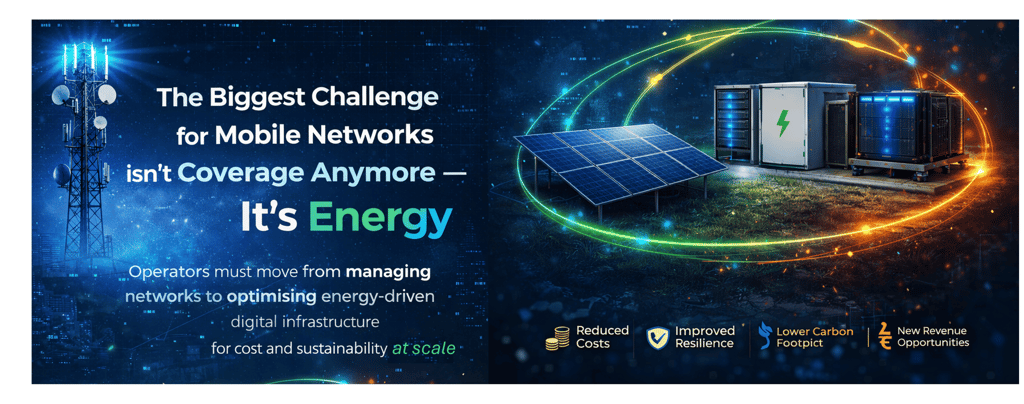
Today, the real battleground for mobile operators and TowerCos has shifted toward energy, cost efficiency, and sustainability at scale.
While "AI in Telecoms" is the industry’s current favourite topic, a critical disconnect exists between the ambition of AI-driven services and the energy infrastructure required to power them. For senior management and investors, the challenge is no longer just "how do we provide a signal?" but "how do we build a power-efficient digital infrastructure that can survive the AI revolution?"
The Perfect Storm: Demand vs. Reality
Mobile networks are currently facing a "perfect storm" of conflicting pressures:
Exploding Demand: 5G, IoT, and AI are driving data consumption to unprecedented levels.
Rising Costs: Energy has become one of the largest OPEX lines for operators.
Sustainability Mandates: Net Zero commitments and regulatory pressures are no longer optional—they are becoming part of the license to operate.
The Revenue Gap: Critically, revenue growth is failing to keep pace with the massive infrastructure investment required.
The AI Double-Edged Sword
In most current discussions, AI is presented solely as a tool for optimisation—using algorithms to manage energy usage at existing sites. While this is a vital component that can deliver double-digit cost savings, it is an incomplete strategy.
The industry must acknowledge that AI is also a massive consumer of power. The transition toward edge compute—moving AI processing power closer to the user—requires a fundamental rethink of site infrastructure. Operators must decide now which sites will host AI-compute facilities, as these locations will require significantly upgraded grid feeds. Given that grid providers often operate on lead times measured in years rather than months, a "wait and see" approach is a recipe for strategic failure.
The TowerCo Dilemma and the Competence Gap
The shift to the TowerCo model adds a layer of complexity to this infrastructure evolution. A major question remains: can TowerCos be convinced to make the necessary investments in power systems to support the dramatic expansion in site load that accompanies AI facilities?
Furthermore, there is a looming competence gap. Most operator and TowerCo organisations do not currently possess the internal expertise to design, specify, and deploy the sophisticated power systems required for this new era. Expertise in hybrid power systems, vendor selection for advanced energy hardware, and remote AI-based energy management is often missing from traditional organisational structures. Moreover, to be truly competitive demands world-class expertise. To bridge this, leaders must look toward a partner ecosystem.
Turning Energy from a Cost Centre to a Strategic Asset
The operators and investors who will win in the next decade are those who stop "managing" energy as an unavoidable expense and start "optimising" it as a strategic asset. By integrating platforms like Tower IoT from AN10 Inc, companies can create a connected energy ecosystem rather than relying on isolated site upgrades.
A truly modern energy strategy must combine:
Hybrid Power Systems: Moving away from diesel dependency toward a mix of solar, battery storage, and smart grid interaction.
Real-time Visibility: Using IoT to gain granular data on energy consumption and site conditions across the entire network.
AI-Driven Optimisation: Leveraging AI not just for the network, but to dynamically optimise the power that sustains it.
The Investor Perspective: The New Value Metric
For VCs and Private Equity firms, the valuation of telecommunications assets is changing. The future competitive advantage will not be defined by who has the fastest network, but by who can deliver the lowest cost per bit with the highest efficiency and sustainability.
Infrastructure that is "AI-ready" from a power perspective - featuring resilient, modular, and sustainable energy systems - will inherently carry a higher valuation and lower long-term risk profile.
Conclusion: A Call to Action
The shift from network management to energy strategy is not a technical footnote; it is the core of the business model. Senior management must act now to:
Integrate Energy and AI Strategies: Do not plan for edge compute without planning for the power it requires.
Secure Grid Capacity: Start the years-long process of upgrading site power feeds today.
Build or Partner for Competence: Recognise the lack of internal power design expertise and engage with specialist partners.
The question for the modern operator is no longer "How do we power our network?" but "How do we turn every watt into a strategic advantage?". Those who fail to answer this will find themselves with the fastest networks in the world—and no sustainable way to keep the lights on.
#Telecoms, #AIStrategy, #EnergyEfficiency, #Sustainability, #TowerCo, #DigitalInfrastructure